Vegan wedding
When we first started thinking about our wedding, one thing was clear: all the food will be vegan. It limited our choices, but we didn't want to give up on that. We eat a vegan diet at home. Why? Because it is one of the best ways to significantly reduce our personal carbon footprint, as I will try to explain in this article. Maybe, after reading it, you will even decide to reduce the amount of animal products in your diet.
Glossary
Greenhouse gases: Gases in the Earth's atmosphere that trap heat and contribute to the greenhouse effect, leading to a warming of the planet.
CO2e: Carbon dioxide (CO2) is the dominant, but not the only greenhouse gas. Other greenhouse gases are, e.g., methane (CH4), nitrous oxide (NO2), or refrigerant gases. The effects of these gases are hard to compare: e.g., methane is more potent than carbon dioxide, but also much more short-lived. Therefore, it is custom to use carbon dioxide equivalent (CO2e); it expresses all greenhouse gases in terms of the amount of carbon dioxide that would have the same impact over a 100 year period.
Carbon footprint: The best estimate that we can get of the full climate change impact of something (e.g., an activity, an item, or a lifestyle).
It started with a graphic
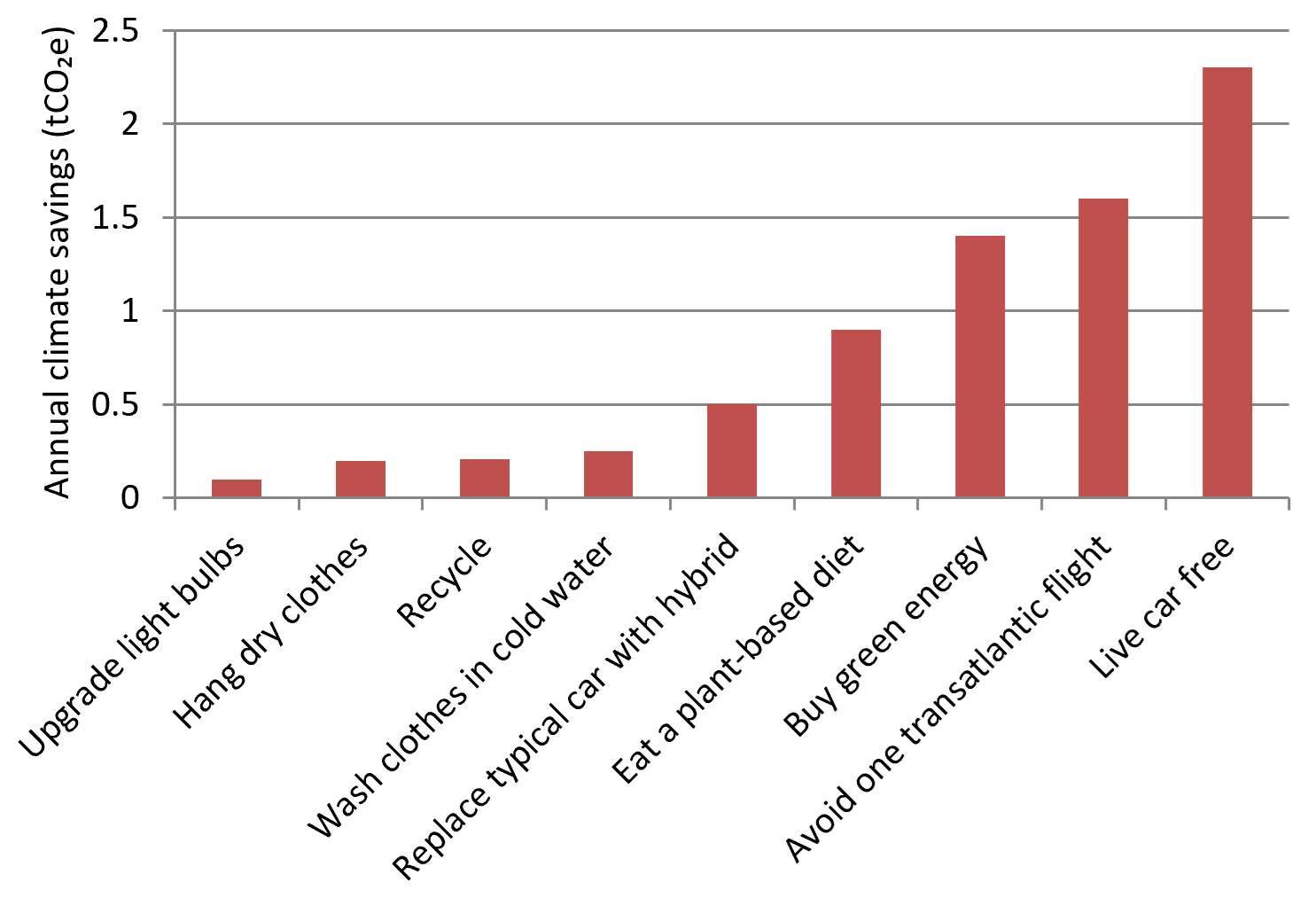
I decided to eat a fully plant-based diet in October 2018. I think there were several reasons and influences, but the main one I remember was seeing a graphic. It compared personal choices that leads to reduction of your contribution to climate change. Since I did not own a car, did not fly much, and lived in a rented apartment with no influence on the choice of energy suppliers, the personal change that would reduce my negative impact on climate change the most was switching to a plant-based diet.
Reinier, when we met, had been mostly vegetarian for years already—he only ate meat when traveling to foreign countries with interesting meat-based cuisine. He supported the idea of not eating animal products at all, and was heading in that direction, just very slowly. Unlike me, he is not one to make rush decisions. However, when we started to live together, I took away from him the hassle of finding the right substitutes, so eating vegan became much easier.
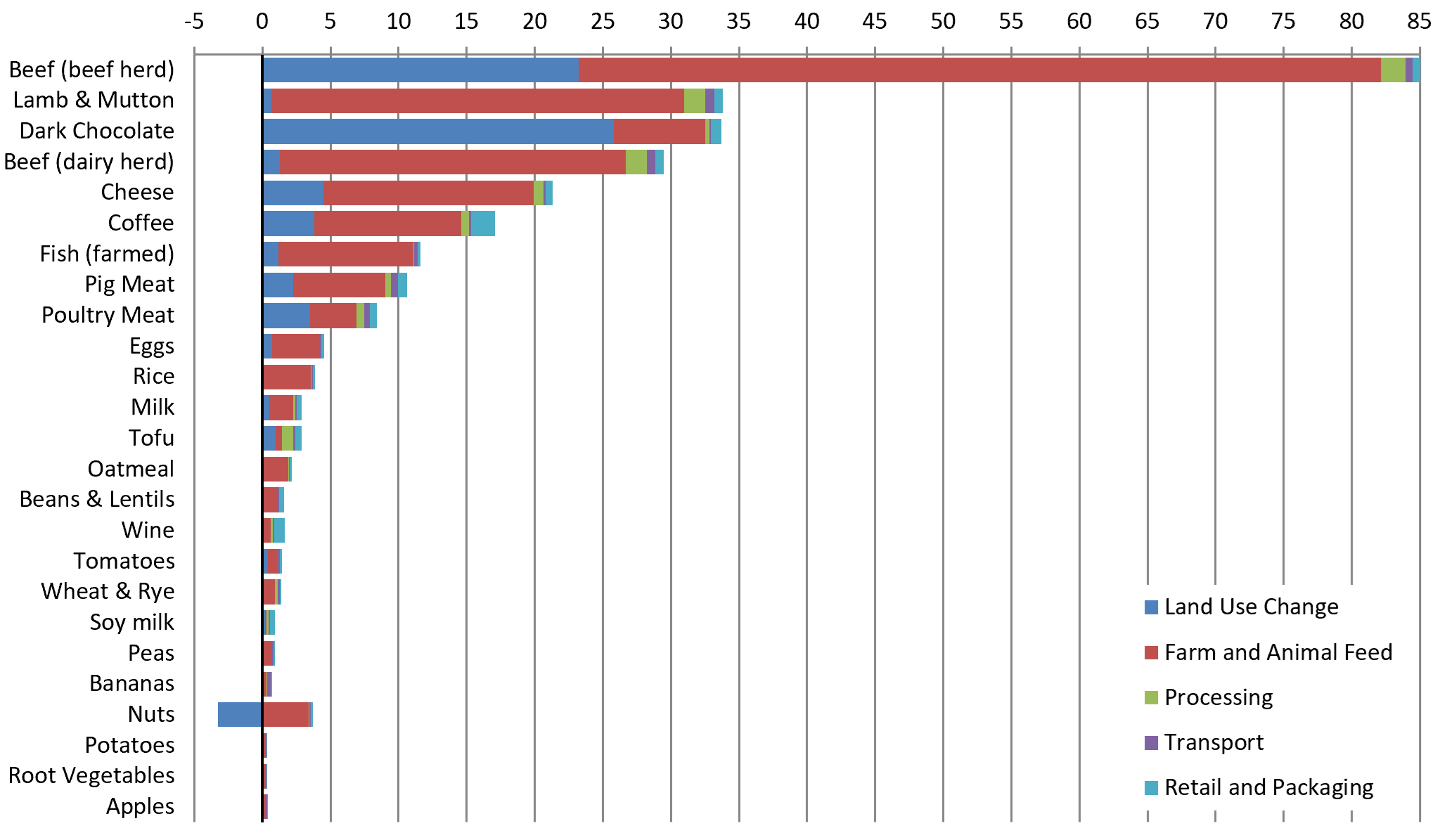
Greenhouse gas emissions per kilogram of food product (kg CO2e per kg product).
Data source: OurWorldInData.org, Poore and Nemecek (2018)
Carbon footprint of food
Take a look at the big graphic: it shows the carbon footprint that is produced per a kilogram of several food products. It can essentially be summarized as "meat is really bad, eggs and dairy are significantly better, but plants are the best". Simply put, this is because animals are very inefficient in producing food. Most of the calories they are fed are spent on the life of the animal, not the final product humans eat. The small graphic below shows, that the most efficient (in terms of calories) is milk, but even that provides only 24% of the calories fed to the animal; the remaining 76% are lost. On the opposite side of the scale is beef: for every 100 kcal you feed to a cow, you get less than 2 kcal back in terms of meat.
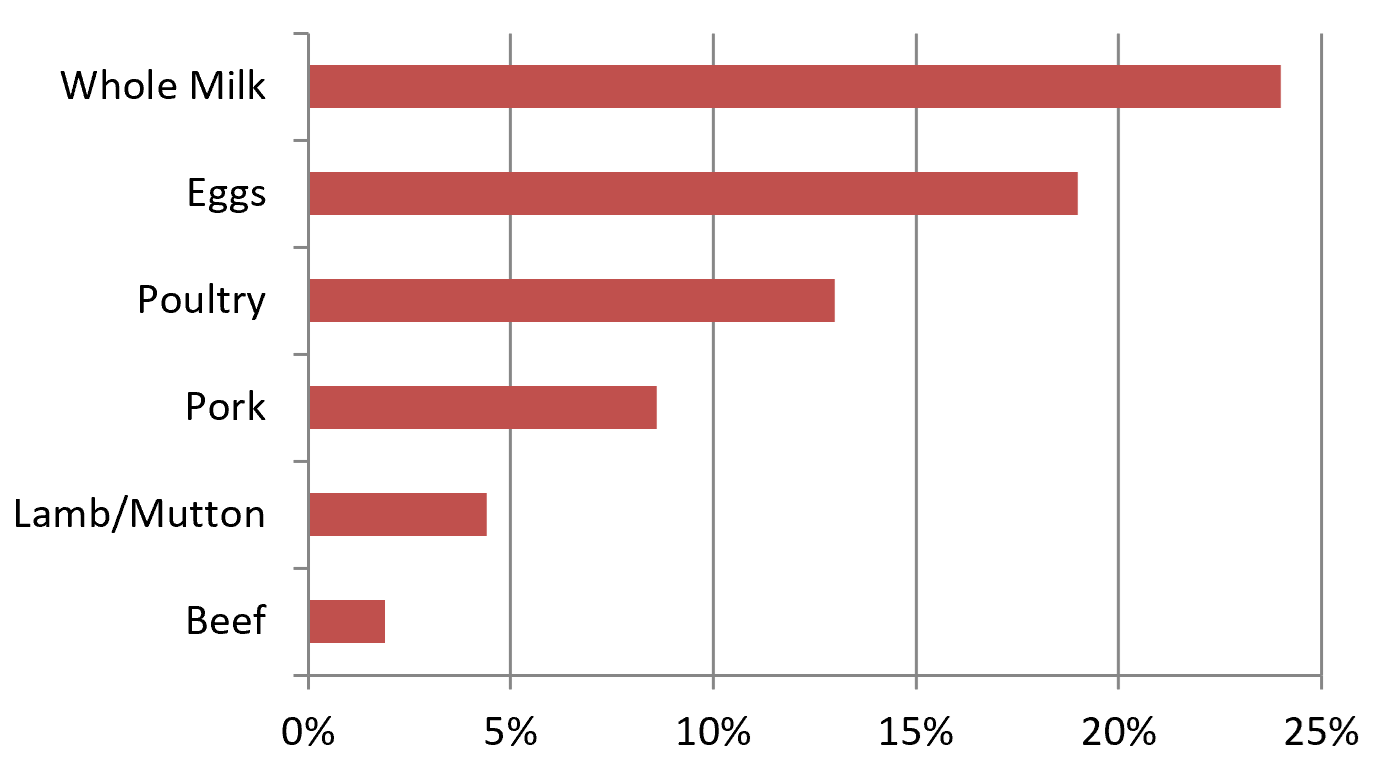
Data source: OurWorldInData.org, Alexander et al. (2016)
Going back to the large graphic, notice that cheese has higher carbon footprint than pork and poultry. So eating a vegetarian diet that is heavy on cheese is not necessarily great for the environment. Of course, the amount matters: coffee has similar carbon footprint to cheese, but a Czech or Dutch person consumes on average about 22 kg of cheese per year, compared to only 2 kg (Czech), resp. 7 kg (Dutch) of coffee beans per year.
Vegan, local, or plastic-free?
A complaint I sometimes get about vegan diet is that eating soy is bad, because soy plantations are a big cause for deforestation in South America. The latter is certainly true; however, the soy products I buy almost always have a sign "soy from the EU". As far as I can say, the soy grown in South America is mainly used as an animal feed.
More generally, we often hear that we should buy local food to minimize our carbon footprint. Is that true? No, not really. Looking at the big graphic more closely, you can see that transport is responsible only for a small fraction of the total carbon footprint. Indeed, for most food products, transport accounts for less than 10% of the emissions. A study shows that it is also true for actual diets: food transport accounts for only 6% of the emissions, whilst dairy, meat, and eggs accounts for 83%.
However, there are exceptions: the main one are products which travel by air. Per kilometer, air transportation emits about 50 times more CO2e than transportation by boat. Which foods are air-freighted? Some highly perishable fruits and veggies -- asparagus, green beans, and berries are common examples.
To make it even more complicated: local fruits and veggies can have much higher carbon footprint than the imported ones. It is the case if the local ones are grown in heated greenhouses. Let's take a look at the carbon footprint of 250 g of strawberries:
| grown locally in season | 490 g |
| frozen | 770 g |
| flown in from South Africa | 3.65 kg |
| grown locally in a hothouse | 3.65 kg |
Amount of CO2e produced by 250 g of strawberries.
Data source: How bad are bananas? (revised 2020 edition)
So it's best to only buy local strawberries in season. And honestly, that's the only time they taste good anyway.
And what about packaging? From the carbon footprint point of view, it doesn't play a big role. On the contrary, plastic packaging of fruits and veggies can help them to stay fresh longer (here I am talking about cucumbers, not about bananas), and hence to reduce food waste. And food waste is a big contributor to the emissions. However, we also want to avoid abundant use of plastic; so yes, it makes sense to reduce plastic waste, it just doesn't reduce our carbon footprint much.
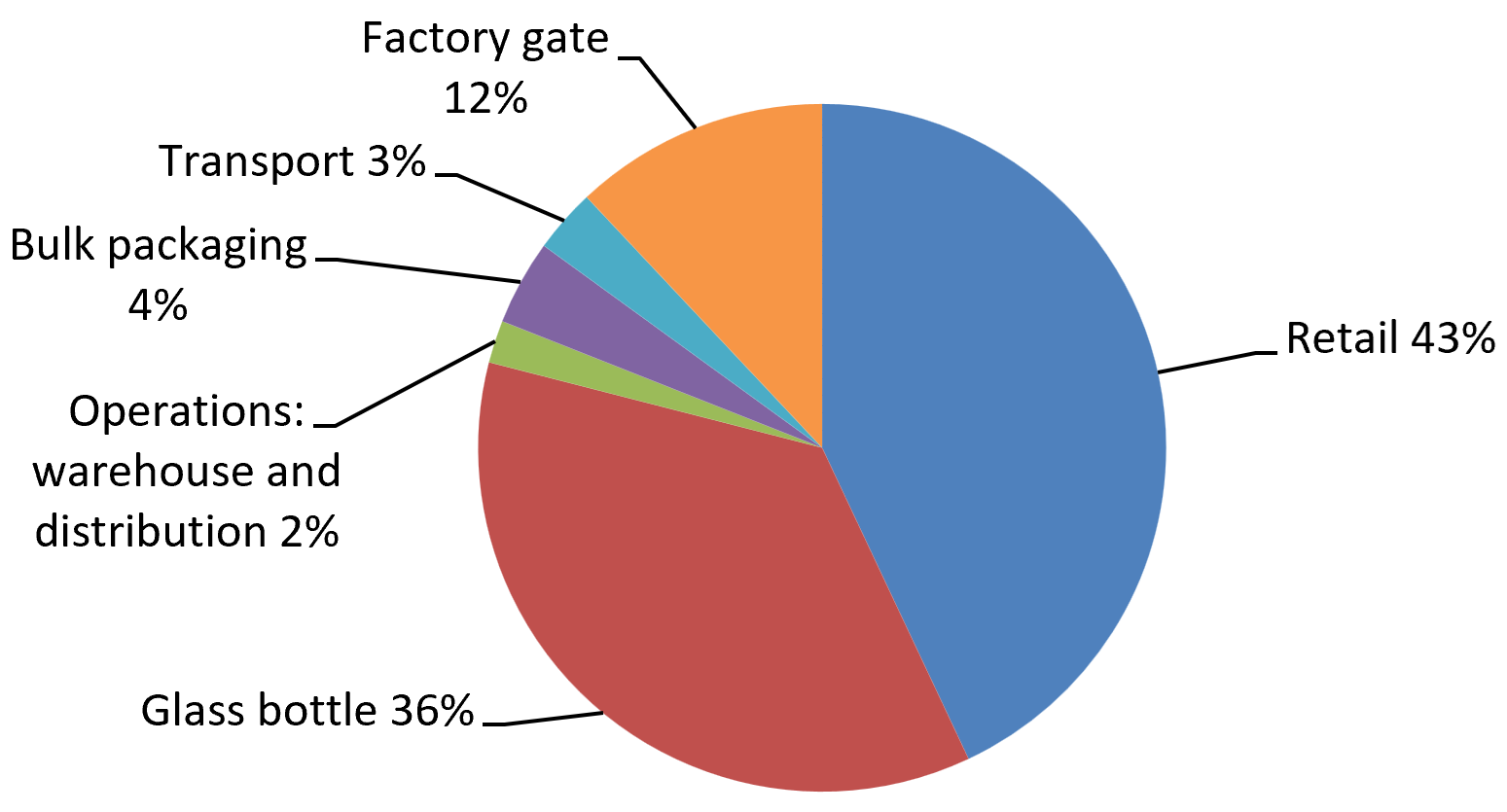
However, there is no rule without exception. Very recently I learned that in the case of wine, the glass bottle typically has a larger footprint than the wine it contains. (Unfortunately, I only found out after I ordered all the drinks for the wedding.) There is a simple solution: buying wine boxes or cartons.
Is a vegan diet healthy?
As with any diet, it depends on what you eat. A diet based on fries and coke is vegan, but certainly not healthy. In comparisons, a vegan diet usually comes out better than omnivores diet -- although that could be due to the fact that many vegans are more aware of what they put on their plate and generally more interested in healthy lifestyle. However, a balanced vegan diet tends to be richer in veggies and fiber and lower in fat than meat-based diets.
Protein
Let's talk about a topic that many people seems to worry about: protein. Can you get enough of it on a vegan diet? The quick answer is 'yes, and it is not so hard'. But let's dig a bit deeper.
The first question is how much protein is actually necessary, because many people seem to overestimate this. According to the WHO (and also the Dutch Voedingscentrum), the recommended daily intake of protein is at least 0.8 grams per kilogram of body weight. Since plant protein is generally slightly less digestible than animal protein, it is recommended to aim for 0.9 to 1 gram of protein per kilogram of body weight. These numbers are higher for small children, pregnant or breast-feeding women, and elderly people (because the body's ability to use protein becomes less efficient). If you exercise, you do not need more protein, unless you train hard for a competition or do a lots of heavy lifting. So, for me and Reinier, this means something between 65 and 75 grams of protein per day.
How do we cover this? Honestly, we do not really count the grams. I make sure to add some significant source of protein to (almost) every cooked meal. We often eat tofu and peanut butter, which are both really good sources of protein (see the table below). We also regularly eat legumes (mainly in curries), and we sprout mung beans and lentils. When we get lazy, we eat vegan meat replacements—as a highly processed food, it is not very healthy, but usually comparable to real meat in terms of protein content.
| Meat and fish sources | Vegan sources | ||
|---|---|---|---|
| Beef (ground) | 17 g | 'Beef' burger | 16 g |
| Pork | 20 g | Tofu | 16 g |
| Chicken | 23 g | Tempeh | 20 g |
| Salmon | 20 g | Lentils | 25 g |
| Vegetarian sources | Chickpeas | 20 g | |
| Eggs | 13 g | Peanut butter | 28 g |
| Gouda cheese | 25 g | Oats | 14 g |
| Quark | 12 g | Seitan | 75 g |
| Yogurt | 4 g | Soy yogurt | 5 g |
| Whole milk | 3 g | Soy milk | 3 g |
Protein in 100 grams of product.
Data source: NutritionAdvance.com and food labels
Supplements
A balanced vegan diet delivers most vitamins in abundance. The exceptions are vitamins B12 and D3.
B12 is the one vitamin that is not present in a vegan diet (apart from nutritional yeast and fortified milks and yogurts). However, this is easily solved by taking supplements. Someone may say that it is better to eat natural vitamins than supplements; I remember reading that nowadays the origin of B12 in animal products is from the same supplements anyway (but I do not recall the source, so take it with a grain of salt). The recommended intake from a single daily supplement for an adult is 25–100 μg.
The second vitamin that needs to be supplemented is D3, especially in winter. However, this is not specific for a vegan diet. Many adults have low intakes and low blood levels of vitamin D3. The recommended daily intake is 20–50 μg (1000–2000 IU).
Additionally, I supplement iron, because I know that my levels are low. But that is not uncommon for women of my age, regardless of diet.
Since I started to eat a plant-based diet, I have had my blood checked several times, which is something I didn't use to do. I also learned that the levels of B12 are not routinely checked (at least in Czechia and Germany); you have to ask and pay extra for it. I highly recommend doing it, even if you are not vegan.
Practical tips
If you are looking for a place to eat, the mobile app (or website) HappyCow is a good source. Apart from vegan and vegetarian restaurants, there are also standard restaurants with vegan options—and also reviews saying whether the vegan options are good. We have used it in several countries, and it always works fine in larger or touristic places.
From the milk substitutes, we like oat milk the most. Soy milk usually contains added sugar, so make sure to select the 'unsweetened' version. Almond milk has even lower carbon footprint than soy or oat milk, but requires a huge amount of water, so we avoid it.
Not all meat substitutes are made equal. Some of them are better than others. So if you didn't like one, don't give up and try others. As a rule of thumb, the ones with a raw meat look are better than the ones that look cooked or fried already (except of chicken nuggets).
You can try to replace meat in your old recipes, but I found it easier to start by looking a completely new ones. Indian cuisine is a great start. When searching online, I prefer blogs and websites that specialize in vegan recipes.
If you want to learn more about the nutrition of a vegan diet, I recommend the book 'Becoming vegan: Express edition' from Brenda Davis and Vesanto Melina.
Remember: it is not about perfection, the first 90% count more than the last 10%.
Are we vegan?
Let us first explain some terminology:
Vegetarian diet: A diet that does not include any meat (not even fish).
Vegan diet: A diet that does not include any animal products, i.e., no meat, eggs, or dairy.
Plant-based diet: The same as a vegan diet. A misnomer, as water and mushrooms are allowed.
Vegan lifestyle: Eating a vegan diet and also not using any animal products like leather or wool.
Note that there is a difference between 'being vegan' (i.e., leading a vegan lifestyle) and 'eating a vegan diet'. We are somewhere in between: we try to avoid any animal products as much as possible (Reinier's wedding shoes are not made from leather!), but we make an exception for merino wool in our sport clothing.